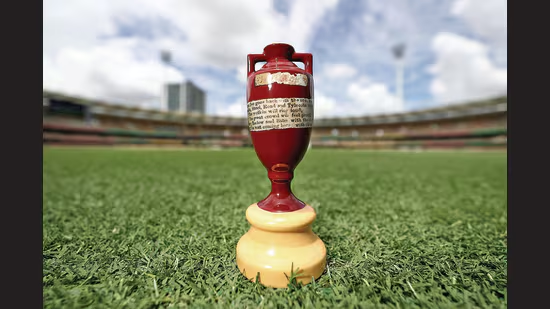
When Ivo goes back with the urn, the urn;
Studds, Steel, Read and Tylecote return, return;
The welkin will ring loud,
The great crowd will feel proud,
Seeing Barlow and Bates with the urn, the urn;
And the rest coming home with the urn.
– The iconic satirical verse from the Melbourne Punch issue of February 1883, cut out and pasted on the Ashes trophy
.
The story of how the Ashes got its name is well-known. It was August 1882 and the Australian cricket team were visiting England for a solitary Test at The Oval. In the second innings, as Australia toiled in tough conditions to set a respectable target for the home side, cricket’s first superstar WG Grace had a particularly ungentlemanly moment.
The visiting captain Billy Murdoch, batting on 29, was gardening in the middle of the pitch after the ball seemed dead, when Grace removed the bails and appealed for a dismissal. It was an event of grave controversy as the two English umpires, Bob Thoms and Luke Greenwood, declared that Murdoch was run out. Australia were dismissed for 122, and England needed just 85 for victory.
The goings-on on the field angered the Australian team, particularly their fiery fast-pacer Fred Spofforth. Spofforth was nicknamed “Demon Bowler” for how quick he was, and because he was, according to his biographer Richard Cashman, “eminently recognisable, with a prominent nose and seemed to reflect the popular physical notions of what the Devil looked like”. An enraged Spofforth orchestrated a devilish debacle for the ages, grabbing seven wickets, five of them clean bowled, to dismiss England for 77 to seal a famous seven-run victory.
Such was the impact of the result that English journalist Reginald Brooks put out this famous death notice in the Sporting Times on September 2, 1882:
“In Affectionate Remembrance of ENGLISH CRICKET, which died at the Oval on 29th August, 1882. Deeply lamented by a large circle of sorrowing friends and acquaintances. R.I.P. N.B — The body will be cremated and the ashes taken to Australia.”
The following year, England captain Ivo Bligh won the 1882-83 away series 2-1 — ably assisted by Charles Studd, Allan Steel, Walter Read, Edmund Tylecote, Dick Barlow and Billy Bates — to take the ashes back home. This journey, marking the birth of an iconic new rivalry, was celebrated by the verse at the top of this piece, and a legend was born.
Like I said, the story is well-known, though its finer nuances beg retelling. What remains a mystery is why the magic of the Ashes — the latest instalment concluded in an emphatic 4-1 victory for Australia Down Under earlier this month — has continued to endure over 74 series since then, traversing Bodyline, Bradman, Botham, Border and Bazball in a manner that no other contest could do.
To be sure, there have been moments in world cricket when other rivalries have grown in prominence. The sport has seen legendary contests between Richie Benaud’s Australia and Frank Worrell’s West Indies in the 1960s, between Clive Lloyd’s West Indies and Ian Chappell’s Australia in the 1970s, between Viv Richards’s West Indies and Imran Khan’s Pakistan in the 1980s, between Steve Waugh’s Australia and Sourav Ganguly’s India in the early 2000s, and the fights for global supremacy between Australia and South Africa in the late Aughts and early 2010s.
Yet while these battles have been intermittent, somehow the Ashes has remained the centrepiece of Test cricket for 140 years, igniting passions and inspiring players to rise to new levels of excellence.
The rules of cricket may have been developed in England, but the country is no longer the financial or spiritual home of the sport. It could, therefore, even be argued that the Ashes is the only series that kept it relevant.
ANYONE BUT ENGLAND
Psychologist Ashis Nandy wrote as early as 1989, in his seminal work The Tao of Cricket: On Games of Destiny and the Destiny of Games, that cricket was an Indian game accidentally invented by the British, theorising that the subcontinent redefined it into a cultural phenomenon that surpassed its colonial origins and intentions.
Soon after, the balance of power started tilting towards our part of the world, and the shift was sealed over the last decade. The fact that India won the 1983 World Cup in England, Pakistan the 1992 World Cup in Australia and Sri Lanka the 1996 World Cup at home played a big part. Though the political spirals in Pakistan and Sri Lanka took a toll on their cricket, India managed to harness the passion into financial muscle through an IPL-induced haze.
The gentle decline of English cricket is a tale older than this transformation. While the rest of the world kept producing inspirational players through the decades, England had precious little to offer the pantheon. If you set Botham aside as a true great of the game, England was fuelled by a bunch of reasonably good cricketers who didn’t classify as standout stalwarts — think Graham Gooch, David Gower, Mike Gatting, Alan Knott, Derek Underwood, John Snow, Bob Willis, Darren Gough, Andrew Flintoff and Kevin Pietersen — between Fred Trueman and Len Hutton in the 1950s and Alistair Cook and Jimmy Anderson in the 2010s.
But somehow the Ashes contests were kept alive through Australia’s relentlessness and England’s flashes of brilliance. So much so that it became the only test of excellence for English cricket. A case in point: even in the current series, Joe Root, arguably the greatest English batter since Bradman’s contemporary Wally Hammond, needed the two hundreds Down Under to get the monkey off his back and stake his claim as the player of this generation.
So, notwithstanding the end of the decade of Bazball — it died at the Adelaide Oval on December 21, 2025, when Australia took an unassailable 3-0 lead to win the Ashes — the Ashes will live on as generations of English players, some very good and perhaps some truly great, strive to win back what was lost on that August afternoon in 1882.
(The views expressed are personal.)