I was tempted to snap photos of every tree. But once I powered down, the buzzing in my mind stopped. I felt centred for the first time in weeks (if not months). Like many, the hardest part of my trip to the jungles of Coorg was the tech-detox. Also read | Is stress wrecking your health? Study says living close to a forest may be the cure
In a world that demands we move faster, I was able to slow down and spend the most peaceful three days wandering the forests of Poomaale Estate, a tranquil 300-acre wilderness collective in the Western Ghats, managed by Beforest.
No phones, no goals, just the five senses
At the serene eco-friendly estate (Poomaale literally means garland of flowers) — where the air smells of damp earth and wild coffee blooms — I tasted a new kind of medicine. It did not come in a bottle, but in the rustle of leaves and the mist clinging to the Brahmagiri foothills. I was able to swap my smartphone for a ‘forest bath’.
Known in Japan as Shinrin-yoku, the practice of forest bathing is less about hiking and more about taking in the atmosphere — a sensory immersion designed to combat the workweek hangover of urban life. Simply put, forest bathing is all about mindfulness and uses the five senses — sight, hearing, smell, touch, and taste — to connect with nature, which in turn reduces stress.
While the term may sound whimsical, the physiological effects are grounded in data. Modern urban living keeps the body in a near-constant state of ‘fight or flight’; and forest bathing acts as a reset button.
Dr Niranjan Singh, senior consultant, internal medicine, CK Birla Hospitals, RBH Jaipur, told HT Lifestyle, “Forest settings offer something that urban spaces do not: quieter sensory input. The absence of constant noise, artificial light, and digital interruptions allows the nervous system to shift out of a constant alert state. For many people, this leads to improved sleep, better concentration, and reduced anxiety. Even short hikes or slow walks through wooded trails can have these effects.”
Dr Singh explained that when we step away from screens and into a high-biodiversity environment (like Poomaale Estate), our physiology shifts: “Spending time in nature, especially in forested areas, has a measurable impact on both physical and mental health. What people often describe as feeling ‘calm’ or ‘recharged’ after a walk in the woods is not just emotional, it reflects real changes happening in the body. Being in a natural environment helps lower stress hormones like cortisol, slows the heart rate, and reduces blood pressure, which is particularly important in today’s high-stress, screen-heavy lifestyles.”
‘A quiet but powerful form of preventive care’
Studies show that breathing in forest air — rich in phytoncides released by trees — can significantly lower cortisol levels. We see a tangible spike in white blood cells and natural killer cells, which are the body’s primary defence against infections and even tumours. It’s not just a walk; it’s a boost to your innate immune system.
Dr Singh explained: “There is also growing evidence that exposure to natural forest air, which contains plant-derived compounds released by trees, may support immune function. Combined with physical activity such as hiking, forest time improves cardiovascular fitness, muscle strength, and joint mobility without the pressure of structured exercise.”
“What makes forest bathing particularly valuable is that it doesn’t require performance or goals. It encourages people to move at their own pace, observe their surroundings, and simply be present. In a healthcare context, it is one of the few interventions that benefits stress, mental health, and physical well-being, at the same time, with virtually no side effects. Regular contact with nature is not a luxury, it’s a quiet but powerful form of preventive care,” Dr Singh added.
The science of stillness
In the age of hustle culture, we are often taught that a successful trip involves checking off a list of sights. But at Poomaale Estate, I learned a different metric for success: the ability to sit still enough to hear the world breathe. Guided by the estate’s team, I learned to peel back the layers of sound.
My days began waking to the call of the Malabar Whistling Thrush rather than a digital alarm. Then came the rustling of leaves beneath my feet as I explored the forest and the distant rumble of a waterfall. But forest bathing isn’t just about your ears becoming tuned to these frequencies; it’s about physical contact with the wild.
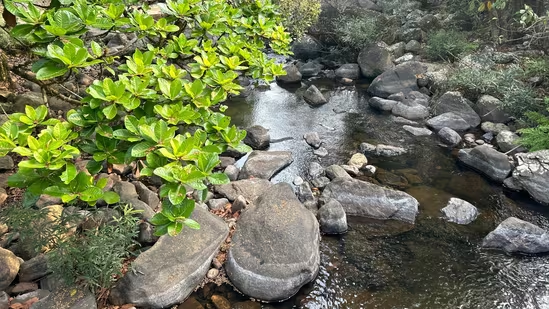
In the total absence of pollution, I went for multiple hikes a day, and between the hikes, I practised the core of forest bathing: observing. Think movements of insects on a leaf, or the hypnotic play of light filtering through the high forest canopy. Apart from the visual experience and soundscapes, forest bathing is woven through tactile connection. From touching a wildflower to running your hand over a tree trunk or holding your palm still in a fast-moving stream, it is about letting your sense of touch support you as you navigate the natural world. It all felt like the childlike wonder that we usually lose by age 10; but the stillness of Poomaale brought it rushing back.
A landscape built for coexistence
Forest bathing aside, the Poomaale Estate is a radical departure from traditional luxury tourism. Of its 128 acres of coffee plantations, forests, sustainable homes and trails, nearly half is left entirely wild. This low-intervention approach allows the land to function as a genuine forest, providing a home for elephants, civet cats, elusive Nilgiri martens, leopard cats, leopards, sambhar deer.
Highlighting how Poomaale Estate was a living laboratory for wildlife harmony, Sharan, a naturalist, who creates immersive outdoor experiences at the estate, said, “There are a total of over 90 species of birds with more than 20 of them being migratory. Some of the interesting birds species are the Malabar grey hornbill, Malabar trogon, white bellied blue flycatcher, Indian blue robin, lesser yellow nape woodpecker, racquet tailed drongo. Every year starting from the month of September, migratory birds start coming and some of them are found until March or April. Moreover, here are around 150 species of butterflies, 30 species of dragonflies, 160 plus species of moths, 11 species of tiger beetles and more that are found in the insect life here.”
The Blyton experience: hospitality without footprint
Blyton Bungalow is the estate’s centrepiece with six rooms and infinite quiet. It is a Kodava-inspired sanctuary constructed from the very earth it stands on — the structure that felt less like a building and more like a natural extension of the surrounding greens and browns.
In the practice of forest bathing, the sense of food isn’t about eating a meal, it’s about the sense of taste and how we ‘ingest’ the forest environment — notice if the air feels thick, sweet, or crisp on your tongue. But at this forest retreat, thanks to the farm-to-table experience, every meal felt like a tribute to the surrounding land rather than just a dish. There was something profoundly grounding about knowing that many of the veggies on my plate had been harvested just yards away.
It was fascinating to see how the Poomaale Estate transformed the abstract concept of forest bathing into a tangible, medicinal experience.
This article was produced following a three-day hosted stay at the Poomaale Estate in Coorg, upon editorial invitation.