When “Oru Mexican Aparatha” was released back in 2017, I remember many people aligned with the left celebrating that movie as a documentation of something their political party delivered. And if you look at that movie closely, the idea was to subtly register the fact that the left opts for violence, and they managed to fool those naive enthusiasts by making them the heroes. I am talking about that film in my take on B Unnikrishnan’s new movie Prathichaya because this movie, in a nutshell, seems like an attempt to give a clean chit to former CM Oommen Chandy in the infamous solar case. However, through that, B Unnikrishnan is actually trying to dive into the inner politics of that party. With the left almost invisible, Prathichaya may not look like an on-your-face propaganda film. But the softer sides of it are evidently visible if you have a basic sense of what is happening in the state’s political hemisphere.
The Cheif Minister of Kerala, Mr. Varghese, is a slightly controversial figure with constant accusations against him for corruption. Even though he managed to tackle all those in the legal battles, an allegation that accused him of sexual harassment shatters him, and he was forced to resign. It wasn’t the way he wanted to leave his political career, and what we see in Prathichaya is the efforts of his younger son, John Varghese, to restore the lost image of his father.
If you look at most of the movies written and directed by B Unnikrishnan, you can see that he always uses some sort of element or event that is popular or relevant, and he will pamper it with his rhetoric. In the case of Prathichaya, he wants to address the dangerous side of corporate infiltration into the masses through freebies. The intention is really good. However, the filmmaking part of it is really flat. The natural upgrade that happens to a filmmaker when newer technologies help them to increase the production quality is the only change we can see in this movie. The style of the writing that does exposition through long and elaborate dialogues is pretty much the same. He is trying to grab the attention of the audience using Dutch angles and stuff frequently when presenting the darker spaces of the story. But it all feels pretty gimmicky.
One of the things that deepened my disappointment with the movie is the fact that in the movie’s promotions, they have basically lied and made many false claims. B Unnikrishnan was asked whether it was about Oommen Chandy and the solar case, and he said something like glimpses and elements of Oommen Chandy can be seen, but the film does not deal with that case, which is untrue. They may have changed the name of the case, the way they changed the name of the character. But anyone with common sense would know which case they are referring to. Also, B Unnikrishnan has claimed that politics is just a backdrop of this movie, and it is actually a father-son relationship story. That is also a false claim considering the fact that the movie predominantly focuses on the power game that happens inside political parties, and the whole family sentiment is rarely driving it. And Mr. Unnikrishnan had also claimed that people like Sabitha Anand and Sharafudhenn are given characters that will be among their most talked-about characters, and that also feels like a very delusional claim. All these claims are actually working against the movie, as most of the developments in the story have a generic feel. You have to be extremely alien to popular cinema to feel goosebumps seeing the strategies of the hero.
On some level, I would say the writing has actually taken the character of Stephen Nedumpally and divided it unequally between the hero and the villain. And frankly, that sort of build-up needs some reinvention as we have been seeing it a bit too often these days. The steps the hero takes to build an image are quite predictable. And just like most of the B Unnikrishnan scripts, we have him flaunting his knowledge about data being used as currency and several other things getting presented as a speech rather than showing us the impact of it in a palpable way. Chandru Selvaraj’s cinematography focuses more on bringing grandeur and style to the visuals. The background score is somewhat excessive in many places, almost like trying to balance out the lack of euphoria in the visuals. One of the most talked-about elements of this movie was the opening sequence of the film, which had thousands of junior artists. The final out with all those cuts rarely managed to capture the scale they were talking about.
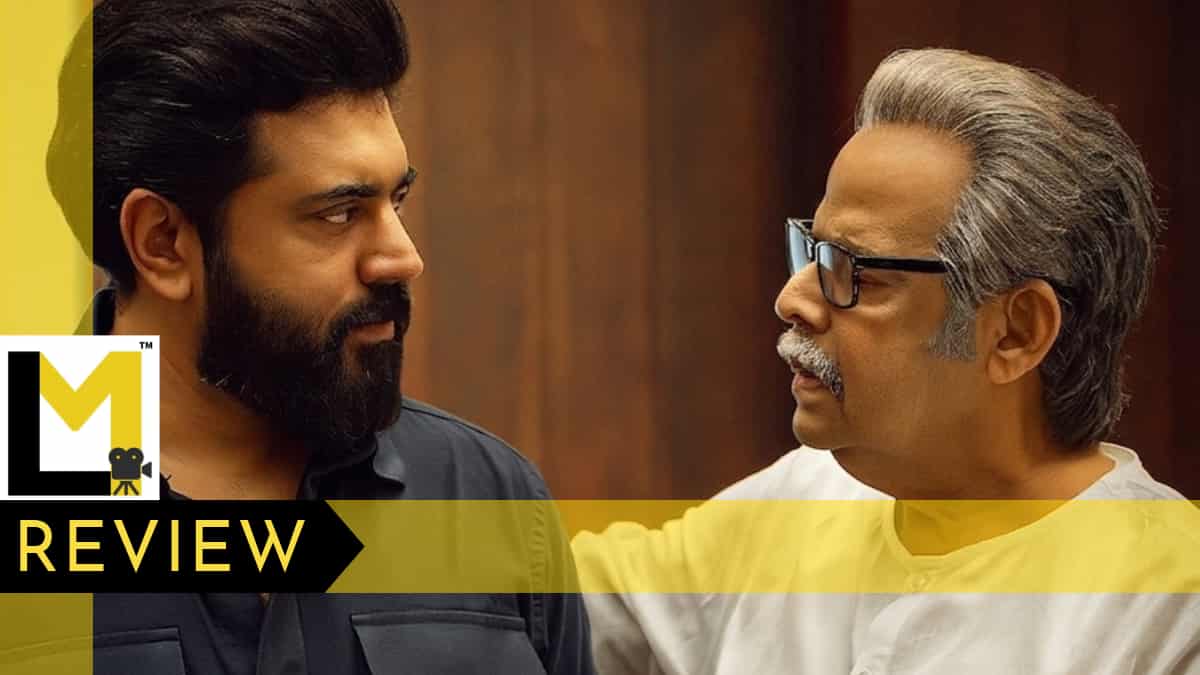
I was curious to know how someone like Nivin Pauly, who delivers lines naturally, would render dialogues written by someone like B Unnikrishnan. To be honest, the contradiction of their style results in an overall dullness to the so-called punch dialogue moments of this movie. Balachandra Menon, as the CM, plays the role pretty effectively, and I thought he was the only actor who matched the dramatic level of B Unnikrishnan’s writing. Sharafudheen, as the antagonist, rarely has anything challenging to do, and he is always walking in slow motion, wearing stylish costumes, and walking out of posh vehicles. If that one scene of Sabitha Anand is a great scene, according to B Unnikrishnan, then it is like admitting that we have not given her anything great. Harishree Ashokan is somewhat forced to overdo the expressions to convey his character’s negative intentions. Nishant Sagar’s portrayal of the elder brother of the hero felt comedic. Neethu Krishna, who was also there in Sambhavam Adhyayam Onnu, is playing the part of the female lead. Even though her screentime is limited, she feels like a promising talent. Saikumar’s screentime and the presence of the left in this movie are almost the same. We have talented actors like Vishnu Agasthya and Vyshakh Shankar playing these extremely stereotypical characters. Ann Augustine plays a crucial role in the film, but in terms of scope to perform, it was actually a nothing role.
If being cunning can be appreciated as smartness, I would say B Unnikrishnan deserves to be appreciated for his writing. In this movie, the hero and his father are not shown as clean politicians. The father himself admits that he has committed corruption, but he knows how to tackle that. He is even shown as a man who denies compensation to a woman whose husband became a victim of police brutality. And if you look at the son, his image-building process is also cleverly manipulated. By making the main case in the story a fabricated one, B Unnikrishnan sort of escapes from the possible allegation of it being against the current opposition. But in that process, he is clearly painting them as a group of corrupt politicians greedy for power.