More than a decade ago, a small uninhabited island in the Gulf of Mannar named Vaan split in two. In months, its northern half had vanished under the sea.
What was left — a green patch of land just off the coast of Tamil Nadu — was slowly being swallowed up too. By 2015, it had lost 84% of its land area.
Decades of coral mining and coastal erosion from rising sea levels amid the climate crisis were destroying what had once been a biodiversity hotspot, home to endangered dugongs, molluscs, dolphins, whales, sea turtles and numerous species of fish, as well as coral reefs, seagrass beds and mangroves.
In 2016, a team of marine researchers joined hands with the government of Tamil Nadu and set themselves a mission: to keep what was left of the island above water.
Today, the erosion of Vaan has been successfully halted, using artificial reef structures (more on that in a bit). Its land area has gone from 20 hectares in 1969 to eight hectares in 2009, 1.53 hectares by 2015 and 3.79 hectares today, with plans to slowly expand it further.
What’s more, it has told the government of Tamil Nadu that saving an island is possible.
This matters, because Vaan is one of 23 such formations that dot the Gulf of Mannar, the shallow bay in the Indian Ocean that stretches between India and Sri Lanka.
Two of the 23 have vanished. The answer to the question “Can the rest be saved” wasn’t clear. It is now.
REEF THERAPY
The 21 islands are so vital as ecological hotspots that they form part of South East Asia’s first marine biosphere reserve (established in 1986). But that isn’t all.
“Together with the coral reefs, these islands act as natural barriers defending the nearby mainland coast from erosion,” says Supriya Sahu, additional chief secretary for environment, climate change and forests with the government of Tamil Nadu. “They protect the coast and its people from storms, cyclones and tsunamis. During the Indian Ocean Tsunami of 2004, they acted as key barriers.”
For all these reasons, in July, the state government began working to save its second island: Kariyachalli, not far from Vaan.
“Kariyachalli’s landmass has shrunk 71.37 percent, from 20.86 hectares in 1969 to 5.97 hectares in 2025,” notes a 2025 Environmental and Social Assessment report published in January 2025 by Indian Institute of Technology-Madras (IIT-M) and TNSHORE (the Tamil Nadu Sustainability Harnessing Ocean Resources), a state-government initiative supported by World Bank.
Without intervention, it is estimated that Kariyachalli would be gone by 2036. So, in September, the deployment of artificial reefs began.
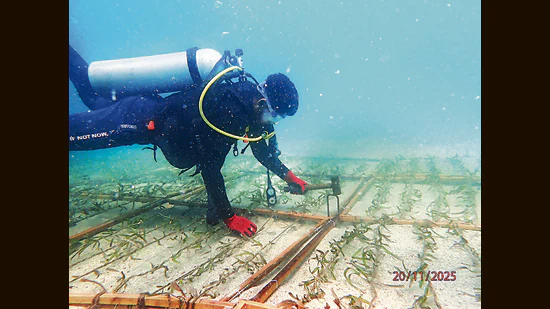
At Vaan, more than 10,000 such modules were attached to the remains of the island. These structures dampen wave forces to arrest erosion, helping maintain land area. For Kariyachalli, the proposed number of reefs stands at 8,500. As with Vaan, they will be made of ferro-cement and steel reinforcement.
“Each island in the Gulf of Mannar is different in terms of orientation and coral or seagrass distribution around it. Hence, the reef module has been redesigned considering this bathymetry,” says SA Sannasiraj, professor of ocean engineering at IIT-M.
Mathematical models of wave energy have been used to determine how the blocks should be shaped and where they should be positioned. The trapezoidal structure selected encourages sediment deposits; the crevices between blocks and the flat surfaces are hospitable to marine life.
Along with these structures, seagrass beds too will be planted, to further slow ocean currents and enhance biodiversity. The endangered dugongs in particular are expected to benefit, since they feed on these plants.
The process of placing the reefs and planting the seagrass is expected to take about 18 months. “Constant monitoring will be key,” says Sahu. One of the concerns, for instance, is that the growing fish populations could attract a growing number of predators, causing what is called a sink habitat. “We will monitor the area for at least five years after completion of the project, to record long-term changes and impacts,” Sahu says.
A budget of ₹50 crore has been earmarked for the saving of Kariyachalli. There will likely be more such efforts. The islands need the help, amid climate change, Sahu says. And, given the crucial role they play as protectors, “the money spent on such projects is very small.”