If we could wander through a Jurassic Age forest from 160 million years ago, at least a few species would seem oddly familiar (and no, not from the movies).
Amid the strange undergrowth, we would see small, raptor-like dinosaurs (some as little as 2 ft tall) scurrying around, covered in fuzzy coats. With their slender bodies, three-toed feet and curved claws, these dinosaurs mark the point in evolutionary history where the story of birds begins.
Over the next 70 million years, the fuzzy filaments would evolve into complex feathers; tails would shrink; arms would widen into wings; snouts would narrow and curve into beaks; bones would lighten; teeth would fall away; diets would change… oh, it would take so much, before they could finally soar.
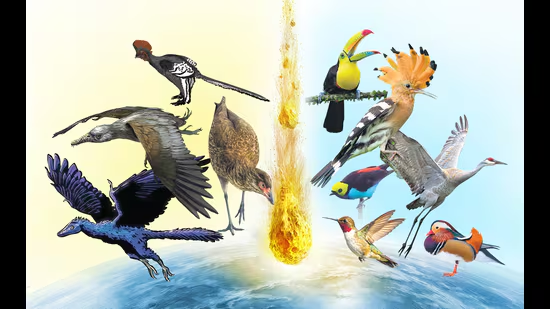
And then, just as these vertebrates were evolving to balance it all — weight, energy levels, wingspan, velocity — well enough to take to the skies, the Chicxulub impactor hit.
Most life on Earth was wiped out. As the skies darkened and towering tsunamis swept across the land, 75% of species went extinct. Many early birds did too.
Among the species that survived, the ability to leave the ground and travel long distances suddenly became a game-changer.
Birds would blossom and flourish in this period, swiftly making their way towards the constellation of exquisite forms we know today.
***
But how did it all begin? Why did the little dinosaurs evolve the early filaments at all?
Studies indicate that the theropods’ short, hair-like filaments likely evolved to help small dinosaurs regulate body temperature, glide across short distances, and perhaps even signal to mates.
After the filaments came a somewhat awkward stage, as the animals slowly evolved towards flight.
Some developed wing-like appendages, but also retained jaws full of sharp teeth, and long, bony tails. Fossils from this stage, of the Anchiornis huxleyi (about the size of a pheasant) and the raven-sized Archaeopteryx lithographica, have been dated to 160 million years ago.
What about the pterodactyls, one might ask?
Well, they weren’t birds. They walked on four limbs and had wings made of muscle membranes. They could fly; some of them over long distances. And they evolved about 220 million years ago, making them the first known vertebrates to take to the air. But they went extinct after Chicxulub, marking the end of that evolutionary experiment.
Back to the early avian species, by about 131 million years ago, the first toothless, beaked birds appeared. The crow-sized Eoconfuciusornis had a grey body, black spotted wings and red throat patch. With a high metabolic rate, its diet likely consisted of small fish that it snapped up with its beak.
By about 125 million years ago, there was the raccoon-like Sinosauropteryx, which had shrunken forelimbs and feathers but no wings; and the four-winged pigeon-sized Microraptor, which was still too unwieldy to take to the air, but may have lived at least partly in trees.
***
Then came real flight.
The earliest ancestor we know of with the characteristics of a bird (bipedal, with a light skull, unfused face bones, toothless beak, slender limbs) is the Asteriornis maastrichtensis, nicknamed the wonderchicken because of its chicken-duck hybrid appearance.
This was a small, terrestrial shorebird dated to 66.7 million years ago. It is one of those that survived the impactor.
Its respiratory system had likely evolved to support the high-energy demands of flight. It had a digestive system that allowed for a generalised diet of foraging (a mix of seeds, berries, insects, small fish) rather than specific prey.
The wonderchicken wasn’t alone.
Fossils of other avian species from this period have been found around the world, indicating that they travelled across long distances (helped along by the fact that climates were stable and continents, far closer). Most of these birds were sparrow-sized, and had flexible shoulder joints primed for the flapping of wings.
***
How did we get from there to the brilliant array we know today?
We are still learning about that arc.
Last February, for instance, a contemporary of the Archaeopteryx from 150 million years ago was discovered in China. Named Baminornis zhenghensis, it has, of all things, stubby wings and a short tail. It looks, in fact, quite like a rooster — pushing back the timeline on that tail trait by at least 20 million years.
The avian evolutionary timelines, in fact, are so jagged and fluctuating, the traits so seemingly mixed-up, that one could be forgiven for taking to the fantasy-fiction writer Terry Pratchett’s mock theory: that a stroke of magic gone wild caused a rash of strange creatures to appear, disappear and become fossilised, all in an instant, leaving the world forever befuddled by the group of animals we later classified as dinosaurs.
Or, as the experts more soberly put it: “Having a short tail appear 20 million years earlier than previously known points to an unknown diversity of really early birds.”
That’s Joanne Cooper, a senior curator of avian anatomical collections at the Natural History Museum, UK. Her book, Birds: Brilliant and Bizarre (2025), explores how some of these early ancestors adapted after the asteroid strike.
***
Chicxulub, of course, changed everything.
The shrieking, hissing crash of the impactor is believed to have been the loudest sound ever generated since life began on Earth.
This was an asteroid larger than Mount Everest, that struck present-day Mexico at 20 times the speed of a bullet. It drove itself so far into the ground that, in moments, the rim of the 100-km-wide crater held peaks believed to have been higher than the Himalayas are today; they soon collapsed amid the chaos.
In the immediate aftermath of storms, wildfires and a violent climate, almost all dinosaurs were wiped out… except some of those that could fly.
The adaptations they had already made, in order to fly, would help them cheat extinction. Key among these was size. The bird-like dinosaurs were relatively small, and thus needed far less sustenance. This helped them survive in a blighted world.
Life cycles and nesting habits would now change rapidly. Early birds began to reproduce more quickly.
***
But there is only that much one can change about oneself.
Even with their low energy demands and ability to fly far for food, the trees were nearly all gone.
Birds that couldn’t live without the trees perished.
“The subset left behind were the small, ground-dwelling ancestors of chickens, ducks and other fowl, and the ancestors of birds such as the emu and ostrich,” says evolutionary ecologist Sahas Barve, programme director of avian ecology at Archbold Biological Station research institute in Florida. “They adapted and spread to new environments and occupied different roles in ecosystems, which contributed to their massive diversification.”
All of today’s birds can be traced to three major lineages that survived this period: the Galloanserae (from which chickens, ducks and other fowl descend), the Palaeognathae (ancestor to the emu, ostrich and other flightless ratites) and the Neoaves (ancestor to nearly 95% of all birds living today, from finches and kingfishers to herons and hoopoes).
***
On one isolated island continent, it still isn’t clear why, the birds began to sing.
What had been chirps and squawks acquired distinct tunes.
This would happen as recently as 50 million years ago.
Songbirds emerged on the continent of Australia, as it broke away and drifted away from Antarctica. From here, they spread across the ancient continents.
Millions of years later, in another evolution, birds began to colonise new high-altitude environments. They grew soft, fluffy feathers with threads of down lining the spaces between them; and loose barbs that trap air and warm it close to the body, increasing the effect of the insulation. Today, these altitudes represent some of the fastest-warming regions on Earth, Barve points out, “so being able to study and predict the cold tolerance of such birds could help forecast their responses to climate shifts.”
Other evolutions continue.
Beak sizes are changing, for instance, with changing habitats.
In the US, dark-eyed juncos, a common North American songbird, has been evolving shorter, stubbier beaks to feed on crumbs and food waste in cities such as Los Angeles. Those that remain in the Santa Monica mountains, their original habitat here, retain the longer, sharper beaks that evolved to crack open seeds.
In many ways, this group of animals, if only because of their capacity for flight, are among Nature’s ultimate catastrophe survivors. But they remain exquisitely fragile beings.
“They are finely tuned to their surroundings, and for that reason, remain some of our most reliable barometers of environmental change,” says Barve.
Today, 61% of bird species worldwide are in decline, according to the International Union for Conservation of Nature (IUCN) Red List. The most critical threats birds face are habitat loss and degradation driven by agricultural expansion, logging, the impact of invasive species, and hunting and over-exploitation for trade.
“It’s a tough world yet again,” says Joanne Cooper of the Natural History Museum, UK, “for these incredible survivors.”
.
THE SURVIVAL PLAYBOOK
One the one hand, flight offers some of the most dramatic evolutionary advantages in Nature: escape, enhanced habitats, rapid long-distance travel.
On the other hand, in order to leave the ground, a body has to give up a lot.
It can be hard to find ways to keep going, with no hands or paws, no quills or teeth. A body that flies can only accommodate so much weight and muscle too. So how to carry things, access food, or simply make it through the winter?
Take a look at some of the most dramatic ways in which birds have adapted, in order to survive.
CUSTOM TOOLS
Some species evolved hidden pouches, special beaks and long necks as ways to store sustenance, crack open resistant foods, and protect themselves and their nests.
Species such as the Clark’s nutcracker have enlarged, expandable throat sacs that let them hoard 30 to 150 seeds at a time, until they can hide them away.
Spoonbills have highly specialised, sensitive, wide-tipped beaks that they use like a precision tool to snap up small prey such as shrimp. Packed with nerve endings, the bills allow them to hunt quickly and effectively in murky waters without even having to see their prey.
Hawaiian honeycreepers possess some of the longest, most sharply curved beaks, to allow them to sip from flowers and pick insects out of bark. Unfortunately, the arrival of humans on the islands of Hawaii about 1,400 years ago and the subsequent arrival of mosquitoes caused most of them to go extinct; the species is now endangered.
Ocean-wandering birds have it harder and tend to develop enlarged olfactory lobes, so they can sniff out a meal from over 1 km away.
Northern gannets, famous for their high-speed dives into the sea, have evolved special muscles behind their skulls to prevent their slender necks from snapping when they hit the water, or the fish, since they often hurtle up to 148 ft, at speeds of nearly 100 kmph.
STRANGE DIETS
A starving bird is an unpredictable thing.
Great tits in Hungary are only about 5 inches long, and for most of the year subsist peacefully on berries and seeds. In the region’s harsh winters, however, with food of any kind scarce, they resort to rather violent tactics. Entering the caves of hibernating bats, they use their short, strong beaks to peck at their skulls to get at their brains. The woozy mammals may wake partially from their slumber but can often do little to fight back. (Talk about a horror story.)
Vampire finches, meanwhile, have evolved sharp, pointy beaks that allow them to draw blood from larger seabirds such as boobies. This unusual feeding behaviour likely began with the finches plucking parasites from the larger birds’ plumes, as a part of a mutually beneficial relationship. As a result, the seabirds probably still view them as cleaners rather than threats. At most, they may view them as pests (the way we view mosquitoes), and likely prefer not to expend the energy it would take to fight off their small ingressions.
RICH COLOUR VISION, A HIDDEN COMPASS
Birds have evolved the most highly advanced tetrachromatic vision system in vertebrates, which lets them see four primary colour channels as compared to humans’ three.
For instance, invisible to the human eye, male mallards display iridescent UV-reflective plumage on their head and wing patches to indicate superior foraging skills (via access to more carotenoid-rich foods) to prospective mates.
Similarly, throat feathers in male European starlings glow brightly under black light as testament to their high testosterone levels and overall health.
Migratory birds such as European robins also use an invisible biological compass: the Earth’s magnetic field, which they detect with the help of light-sensitive proteins in their retinas. When solar flares or geomagnetic disturbances disrupt this delicate system, they often halt journey. They can’t continue because the map simply isn’t visible anymore.