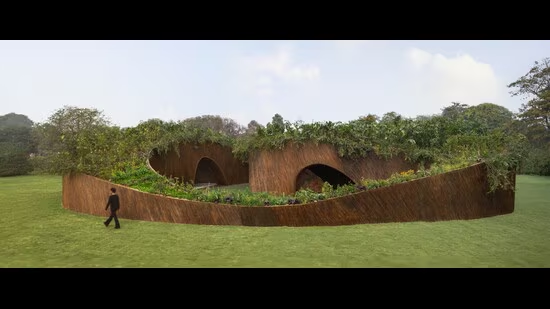
It looks like a small spiral land formation rising out of the lawns of Delhi’s Sunder Nursery.
The Aranyani Pavilion is made primarily from upcycled Lantana camara stems (notorious for invading and choking native landscapes), turning ecological debris into an architectural statement.
A biodegradable bamboo skeleton holds it up. It is crowned by a living canopy of jasmine, neem and tulsi plants.
At its heart, a nine-tonne rock that was dredged up as waste during a mining operation in Rajasthan sits in a still, shallow pool, the water reflecting the sky above.
The spiral walls that lead visitors inward form a rib-like cage that seems to breathe in the damp air.
The Aranyani Pavilion is the centrepiece of a 10-day event curated by conservationist and artist Tara Lal, from February 4 to 13.
“It is inspired by the idea of sacred groves, which, around most cities, may eventually be the only forest patches that are truly preserved, safeguarded by local communities for generations,” says Lal, founder of the ecological restoration initiative Aranyani (named for the Hindu goddess of forests and wild animals), which has worked with local communities on rewilding and groundwater recharge projects in Meghalaya, Rajasthan and Himachal Pradesh.
The spiral itself, adds Lal, who has also designed the pavilion, mirrors Nature’s recurring motif, in shells, leaves, galaxies and the DNA of life itself.
“It’s a reminder that we belong within the world, not apart from it,” Lal says.
ROOTING FOR CHANGE
Step into the pavilion’s two galleries, during the 10-day calendar of events, and one may opt to join a guided breathwork session; attend a talk titled What We Were Never Taught, by British journalist and author Sathnam Sanghera, exploring how histories of colonisation continue to shape land, economy and ecology.
There will also be sessions on ecological leadership, led by women leaders of corporate sustainability efforts and grassroots design initiatives.
The Pavilion will host experiential sessions on urban farming with Nabanita Bajaj of Anahata Organic Farm; discussions on architecture in a time of ecological change; and on the future of organic food and slow living.
The idea is to encourage visitors to interrogate their lives from the lenses of rhythm, reciprocity and restraint; and, vitally, sustainable ethical response amid an ecological crisis.
On the ground, Aranyani does this most widely by helping communities and private individuals rewild part of the lands they own.
In Meghalaya, for instance, communities are protecting biodiversity by reviving traditional food systems with the help of Aranyani. Over 200 types of wild edibles are being incorporated into school meals across seven villages.
In the same spirit of community engagement, after the event, the pavilion at Sunder Nursery will be donated to the Ratnavati School for Girls in Jaisalmer, where it will serve as an eco-training or environmental studies space (with the living rooftop replaced with plant varieties native to Rajasthan).
CIRCULAR THINKING
The hope is that the event on the whole will help people think more deeply about their natural environment, journalist and author Sanghera says.
“My session will focus on how the history of plants epitomises Indian and British Imperial history, and continues to have an impact, because people rarely think in terms of plants having a history,” he adds. And yet, this history is vital. It alters our ecosystems, affects water tables, alters cultures.
Older wisdom is urgently needed today, adds Nyrika Holkar, an executive director at Godrej Enterprises Group, who will be speaking on leadership and ecology at the Aranyani event.
“Prosperity without care is fragile and leadership without responsibility to Nature and society is incomplete,” she says. “This is deeply relevant today because we are living at a moment where the consequences of short-term thinking are impossible to ignore — climate stress, water scarcity, biodiversity loss. Whether you’re a business leader, policymaker, designer or citizen, the central question is the same: Are we optimising only for profit and speed or are we stewarding for resilience, equity and continuity?”
The pavilion is an invitation to reconsider how we build, how we belong, and how we pass values of ecological custodianship to the next generation, adds Lal. “Children, after all, are born close to nature. It is we who gradually pull them away.”
(The Aranyani Pavilion events are free and open to all)