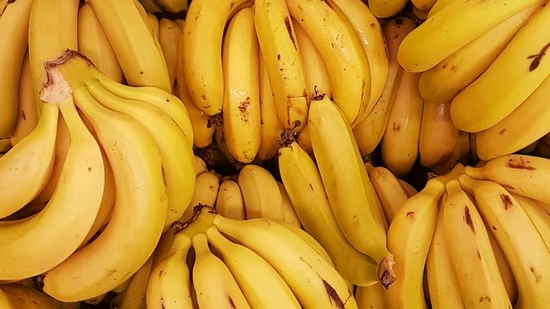
Bright yellow bananas may look picture-perfect on store shelves, but not all of them have ripened naturally. In a race to speed up sales and reduce losses, some vendors are reportedly forcing bananas to ripen using chemical agents, turning prematurely harvested fruit yellow before it has properly matured from within. The result? Bananas that appear ready to eat but may be underdeveloped – and in some cases, exposed to potentially harmful substances. Amid growing concerns around such practices, knowing how to tell naturally ripened bananas apart from chemically treated ones has become more important than ever.
Also Read | Do you remove the liquid that forms over curd? Surgeon explains why you shouldn’t
Dr Manan Vora, a Mumbai-based orthopaedic surgeon, health educator, and co-founder of NutriByte Wellness, is breaking down how to identify the difference between naturally ripened bananas and those that have been chemically ripened. In an Instagram video shared on February 26, the surgeon outlines the key visual and taste indicators consumers should pay attention to, while also explaining the potential health concerns associated with chemically ripened bananas and why they are best avoided.
How to distinguish between the two?
According to Dr Vora, you can often tell the difference between naturally ripened and chemically ripened bananas by closely observing their colour, texture and taste. Naturally ripened bananas tend to have an uneven yellow hue with small brown or dark speckles and a richer, sweeter flavour.
In contrast, chemically ripened bananas usually appear uniformly bright yellow, while the tips at the top and bottom may remain slightly green – and they often lack the same depth of taste.
The surgeon explains, “If the bottom and top parts are green and only the middle part is yellow, it means it has been chemically ripened. Naturally ripened bananas do not have a uniformly perfect yellow colour; they have small dark spots and a rich flavour. Chemically ripened bananas are often forced to turn yellow quickly.”
Why you should avoid them
Dr Vora warns that some vendors resort to hazardous agents such as calcium carbide to artificially ripen fruits, including bananas. In such cases, the chemical treatment merely changes the peel’s colour to yellow, while the flesh inside may remain underdeveloped and lacking in natural sweetness and texture. He further cautions that calcium carbide can contain toxic impurities like arsenic and phosphorus. Regular consumption of chemically ripened bananas, he notes, may contribute to bloating, acidity and overall digestive discomfort.
The surgeon emphasises, “Many vendors use hazardous chemicals like calcium carbide to immediately change the fruit’s colour to yellow. However, calcium carbide only changes the fruit’s color; the internal texture does not mature properly. Additionally, this chemical can contain toxic elements like arsenic and phosphorus, which are not safe at all. Eating too many such chemically ripened fruits can cause bloating, acidity, and digestive discomfort, especially when eaten on an empty stomach.”
Dr Vora recommends always choosing bananas that are slightly spotted and have a creamy texture inside. He concludes, “Remember, a naturally ripe banana is slightly spotted and has a creamy texture, while an artificially ripened one is mostly uniformly yellow and has a bland flavour. Choose bananas that are slightly spotted and naturally creamy inside for better taste and safety.”
Note to readers: This article is for informational purposes only and not a substitute for professional medical advice. It is based on user-generated content from social media. HT.com has not independently verified the claims and does not endorse them.