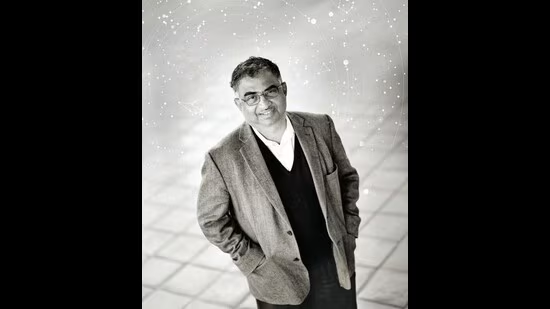
He likes to joke that his initials are SRK, but he hobnobs with a very different set of stars.
Astronomer Shrinivas Ramchandra Kulkarni, 69, loves bunnies, is mercilessly irreverent, and switches focus areas every five years. “I like to identify emerging fields, make a splash and then exit, once the field has become popular,” he says.
It’s an unusual approach, but one that has undoubtedly served him well.
Kulkarni, who teaches astronomy and planetary science at the California Institute of Technology (Caltech), won the $1.2 million Shaw Prize in Astronomy (instituted by Hong Kong businessman Run Run Shaw and known as the Nobel of the East) in 2024, and followed that up, this January, with the highest award handed out by UK’s Royal Astronomical Society (RAS), its Gold Medal.
Kulkarni’s area of specialisation is time-domain astronomy, or the study of real-time change in the universe. What does this mean?
Rather than just an endless canvas to be studied at leisure, he and others like him argue that the universe is also a bit like a bowl of popcorn in the microwave.
Dramatic changes are occurring on all sorts of timescales, from seconds to years, and are visible, if one is watching for them, and knows where to look.
Kulkarni has helped define what to look for, and where, in ways that the RAS citation calls “field-defining… innovative and ground-breaking”.
For an indication of how complex this work is, consider that, even with popcorn, one would have to figure out which kernels to focus on, in what order, and how much information to record before moving on to the next one about to pop.
In astrophysics, the “kernels” consists of things like pulsars and gamma-ray bursts that cannot be seen; only sensed, by certain space telescopes. And are gone in a flash.
***
So, how does he do it? It all started when he was a 26-year-old graduate student at University of California, Berkley, and made his first big splash: the discovery of the millisecond pulsar.
This is a tiny dead star that spins so fast that it acts like a precision cosmic clock, and can be used to minutely explore cosmic gravitational waves. Before Kulkarni, it wasn’t known that there were pulsars (or dead stars) that spun at such rates.
The day he made that discovery, Kulkarni says, remains one of the best of his life. “I couldn’t sleep for several nights, I was so excited,” he says.
About a decade later, as a young lecturer, he and his students discovered the first brown dwarf (a failed star; an object too massive to be a planet and too puny to qualify as a star). This underlined his argument that the universe was very rich, and it pays to look widely.
A few years after that, in the late-1990s, he and his colleagues demonstrated that gamma-ray bursts were extragalactic, making them among the most brilliant or luminous phenomena in the universe, visible even though they formed in galaxies far, far away.
Even for a layperson, his discoveries make it clear that there is dynamic, violent movement and activity playing out, in the vast out-there, not just on the massive scale of supernovas and black holes but at infinitesimal levels too.
This revision of our view of the cosmos is why he has now been placed alongside some of the greatest astrophysicists in history. Previous recipients of the RAS Gold Medal include Albert Einstein, Stephen Hawking and Edwin Hubble.
He doesn’t see himself as in their league, Kulkarni says, laughing. “I mean, we’re talking about Einstein, a once-in-several-hundred-years scientist; and Hawking, a once-in-several-generations genius. If I share anything with them, perhaps it is that we are a league of highly productive scientists who, over our lifetimes, were able to effect some change in this field.”
***
Kulkarni believes he remains productive precisely because he switches focus areas every five years.
His students rib him about it. “I tell them, avoid or abandon popular fields. There is no low-hanging fruit there,” he says, chuckling. “Forget passion or fashion. Choose a less-exploited field and you automatically give yourself a little ‘unfair advantage’. This may sound a bit unbecoming, but in order to do our best work, we must each ask ourselves: in what way can I distinguish myself from the others in my field?”
In this way, he left the focus area of millisecond pulsars as they became a popular area of study in the 1980s, and ended up discovering the brown dwarf. By the late-1990s, with everyone trying to uncover more about this phenomenon, he left it behind him and moved on to gamma-ray bursts.
He isn’t looking to dedicate decades to a single idea so he can win a Nobel Prize; anyway, there isn’t one for astronomy, he says, chuckling. This way, he adds, he gets to live a life of discovery; and what else is life for?
***
About a decade ago Kulkarni found his latest passion: real-time study of transient change in the night sky.
His idea for a facility to conduct such observation would take shape, over a few years, as the Zwicky Transient Facility (ZTF), a telescope system installed in California that began operations in 2017-18. After helping set it up and serving as its chief architect and chief scientist, he handed it over and stepped away.
“A couple of years ago, after we classified 10,000 supernovae with ZTF, I lost interest in this field. For me the novelty had worn off. I was eager to sample other areas of our rich universe! I very happily handed it off,” he says.
***
Kulkarni was raised in Hubballi, Karnataka (his sister, incidentally, is the philanthropist and author Sudha Murty, founder and head of the Infosys Foundation), attended a government-run Kendriya Vidyalaya, looked forward to new editions of Scientific American magazine as a teenager, studied at the Indian Institute of Technology-Delhi (IIT-D), and retains strong ties with the scientific community in India.
In addition to positions around the world, he heads the physical science panel of the Infosys Science Foundation, is an honorary fellow of the Indian Academy of Sciences and an honorary fellow of the Indian Institute of Astrophysics (IIA), Bengaluru, and holds the JRD Tata Chair at the Tata Institute of Fundamental Research (TIFR) in Mumbai. He is a regular visitor at IIA, the Raman Research Institute in Bengaluru and TIFR, where he gives seminars and has taught mini-courses.
What would one find him doing when not gazing at, or teaching about, the heavens?
He loves music, Kulkarni says, but switches genres every few years here too. As a result, he has enjoyed salsa and Hindustani classical music, qawwalis and the music of Brazil and Mali.
At work, he is now exploring his next new frontier: the plasma between stars. He describes it as the “backwaters of the interstellar realm”. There was once great focus on what this in-between material might hold, he says. “I hope to bring it back to its former days of glory!”