Scouting is the invisible foundation on which the success of the Indian Premier League and Women’s Premier League (WPL) are built.
The discovery of certain players through the leagues’ scouting systems (Jasprit Bumrah, Mohammed Siraj, Varun Chakravarthy, Tilak Varma) are now part of T20 lore.
Here’s another example of what the good eyes of a scout can do.
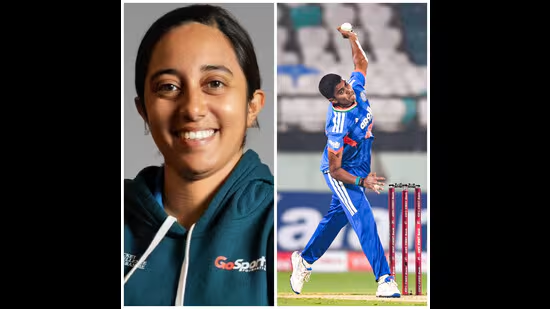
Shree Charani, at the beginning of last year, was just another young cricketer. She grew up in a village in Andhra Pradesh, then made her start grinding it out at domestic Under-23 tournaments. She didn’t know it, but she was being watched from tournament to tournament by the lead scout for Delhi Capitals, former cricketer Ananya Upendran, and her team.
At the 2025 WPL, Charani was a surprise pick for Capitals.
She played just four games, but that was enough for her to get called up to the national squad. A month after making her WPL debut, Charani was playing her maiden ODI; two months after that, she was smashing through the England squad on her first overseas tour; another four months and she was picking up wicket after wicket en route to India’s historic first World Cup triumph, finishing the tournament as the team’s second-highest wicket-taker.
“A truly incredible journey,” Upendran says, as she watches young players in action at an academy in Delhi. “She did it all in one year. And she did it with the same calm temperament with which she played Under-23 domestic matches.”
Scouting is a secretive affair, but one secret Upendran is willing to share is that temperament is a key attribute she looks for.
“Temperament is just measured not over the course of a season or a tournament, but even in the course of a match,” she says. “How does a bowler’s second spell look if they’ve been hit in the first spell? Or, if you’ve been hit for two consecutive sixes off your first two balls, what will you do with the next four balls in the over? There are a lot of small things we examine.”
Upendran, 34, played cricket for 18 years at the domestic level. She has had courtside seats to the transition from empty stadiums with no TV coverage of major matches to a WPL of packed stadiums and major broadcast deals.
“I was at the World Cup final in Navi Mumbai and, looking around me at the packed stands, I couldn’t believe what I was seeing,” she says. “I thought, ‘I don’t know when this change happened.’ It’s been a long time in the making, but it’s also felt like it happened overnight.”
Upendran retired as a player in 2020, and moved into sports journalism. In 2023, when the WPL was announced and franchises began looking for scouts who understood the landscape of women’s cricket in India, she started a new career.
Upendran now attends about 70 matches in the season that runs from October to February. “Last year, I was home for only 18 days in that five-month period,” she says. “The rest of the time I was travelling from Dimapur in Nagaland to Lali in Haryana, Thiruvananthapuram in Kerala to Dharamshala in Himachal Pradesh, filling up notebook after notebook with notes on players.”
As with so much in sport, the work is as rewarding as it is demanding.
“It’s exciting to compare how a player started the year and how they ended it,” Upendran says. “How they grow through a season, and through the years. Sometimes I go back to my old notes to see what I’d written about them, and go to sleep really happy.”
(To reach Rudraneil Sengupta with feedback, email rudraneil@gmail.com. The views expressed are personal)