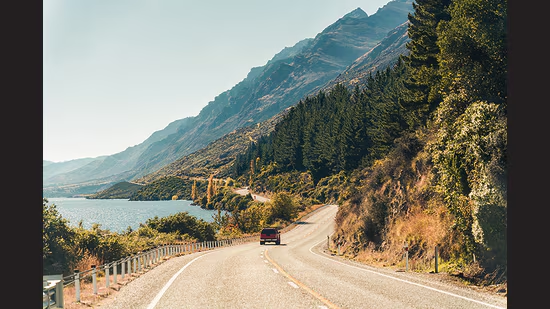
I’ve taken to long-distance driving. That’s why I chose to drive from Mumbai to Kochi, where my mother lives. On my return, on a whim, I asked Uncle Toney, my father’s younger brother, if he would like to drive back with me. I wasn’t sure he would say yes.
Uncle Toney is not a man who does things because someone wants him to. He does them because he decides to. At 77, that distinction matters. But he is also the last of my father’s siblings still standing; the final living link to a time that shaped me without ever quite explaining itself.
So when he considered it and called to say he would ride back with me, as far as a friend’s home in Bengaluru, I understood the weight of the moment immediately.
We agreed to leave early. He is a stickler for time. I wasn’t, as a young man. I now am; I find lateness grating, and sloppiness exhausting. When I reached his door on the dot, he was ready, packed and pleased. It felt like a gentlemanly agreement was being honoured.
Once we were on the road, the regular metrics such as kilometres covered and speed ceased to matter. I felt like I wanted the hours; that the chance for an unhurried stretch of time with him might not come again. It turned out to be a more memorable time than I had expected, our 11 hours together.
Wisdom doesn’t announce itself. It arrives in observations that sound almost too simple to be useful. Uncle Toney was among the earliest Indians to get into motorsport. Cars and bikes were not hobbies for him; they were long relationships. Somewhere on the highway, he said that if I wanted to extract the best mileage from my car, I should drive at about 80 kmph, keep the engine at about 2,000 rpm, and stay in fifth gear or overdrive. No explanation. No elaboration.
He was right. The car settled into itself. The drive grew smoother, less strained. It occurred to me that the advice worked beyond the machine. There is an optimal speed at which effort, wear and progress align. Anything faster costs more than one may realise. Anything slower begins to corrode.
As we made our way north, he spoke about having lived a full life. He said he had no regrets. Not because nothing had gone wrong, but because nothing essential had been postponed indefinitely. He travelled widely when he was young, and kept travelling until his body renegotiated the terms. He ate well, with an emphasis on freshness and quality, because, as he put it, we are given only one body.
He spoke about love, and the importance of being good to the woman you love. In his case, my aunt Jancy. Uncle Toney can be exacting, cranky, difficult. But no one has ever doubted that he loves her completely. Love, for him, is not performance. It is reliability.
As we drove, he talked about the importance of staying in touch with young people. That was part of the reason he was on this road trip with me, he said; once in Bengaluru, he planned to meet a friend closer to my age than his. When I eventually met the man, it made sense immediately. They had a shared love for machines, speed, and the refusal to waste time.
Looking at him as he walked away, I was reminded of the younger Uncle Toney. The man who drove beautifully and was never tired. Who handed over the wheel easily, when I said I wanted to drive.
Age is a cruel thing. It strips away capacity and pride in uneven increments, forcing each of us into denial. On our day together, he kept thanking God for the privilege of the drive. More than once, he said it would be his last long one. I told him I didn’t agree.
As the road slipped past us, it occurred to me that lives like his don’t arrive as gifts. They accumulate. Mile by mile. Decision by decision. Usually without applause.
When we finally parted ways, there was no recap or emotional accounting. Just a quiet “Thanks, son.” That felt right.
Some journeys don’t need to be remembered loudly. They do their work more quietly, resetting the internal compass so that, long after the road disappears, you find yourself living by a better standard than the one you started out with.
(Charles Assisi is co-founder of Founding Fuel. He can be reached on assisi@foundingfuel.com. The views expressed are personal)