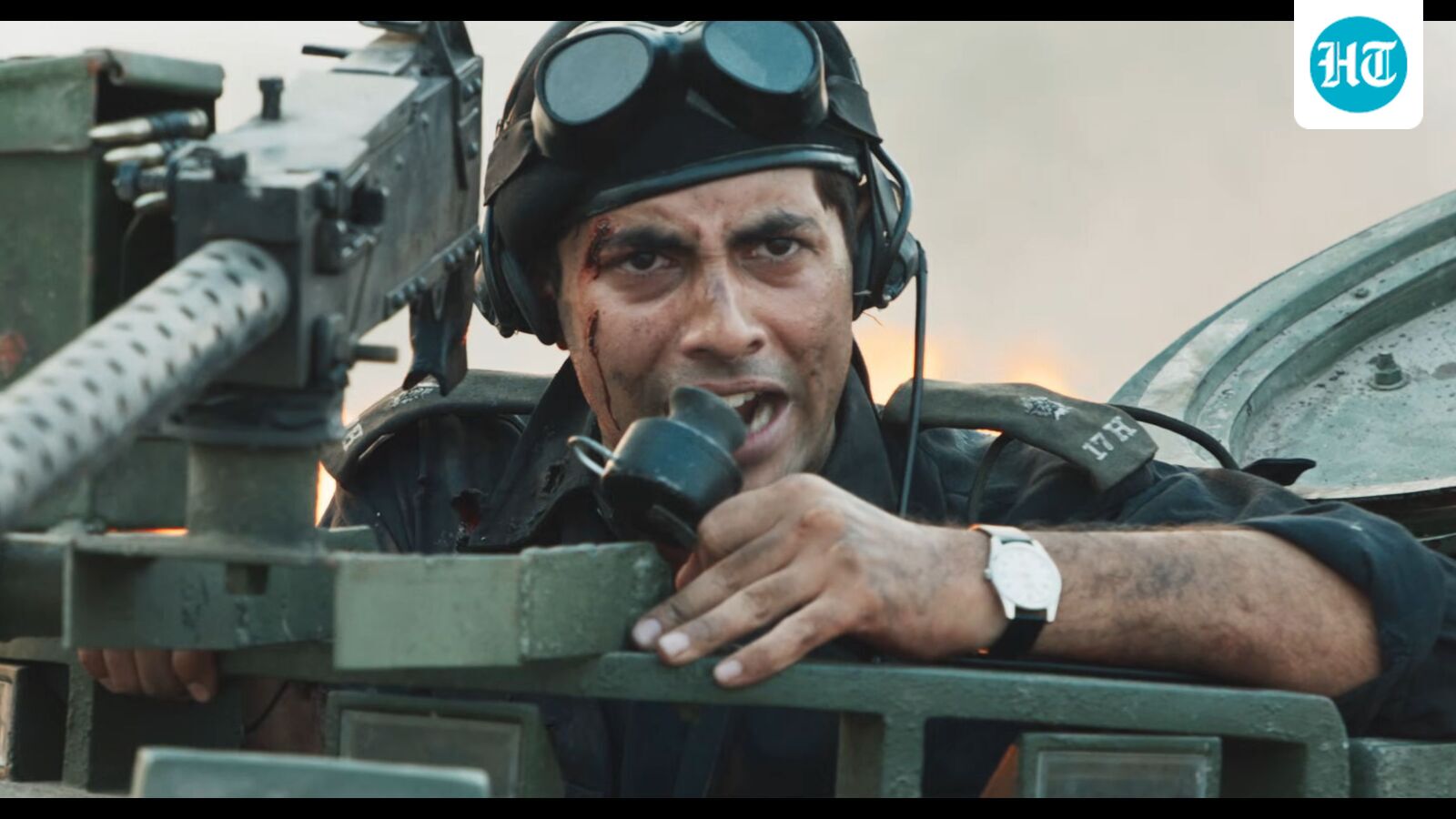
Once in a while, a film shows up in cinemas with the perfect sense of timing. The first Hindi release of the year, director and writer Sriram Raghavan’s soulful war movie Ikkis (2026), is one of those charmed titles.
Coming on the heels of Dhurandhar and three weeks before Border 2, Ikkis is a reminder that there can be more to the Bollywood blockbuster than blunt-force storytelling, and that there can be more to on-screen heroism than gratuitous bloodshed and bitterness.
This year is set to be full of war tales. Upcoming releases include Sanjay Leela Bhansali’s Love and War, starring Ranbir Kapoor, Alia Bhatt and Vicky Kaushal; and Battle of Galwan, starring Salman Khan and based on the 2020 battle with China over Galwan Valley.
It is only January, but I think Ikkis will end up being the most sophisticated war movie of 2026.
To begin with, it has a stellar ensemble cast (Agastya Nanda, Jaideep Ahlawat, Sikandar Kher, even Dharmendra). Mirroring the bright-eyed optimism of its heroes, its storytelling assumes a viewer who is smarter and more open-minded than recent box office results would suggest. The script doesn’t flatten out complexity or tap into propaganda. Instead, it dares to be a war movie that dreams of peace.
Unusually, Ikkis chooses silence over noise and beauty over violence. It delivers lines of dialogue reminiscent of the lyricism of yesteryear writers such as Gulzar and Abrar Alvi.
The film is about a real-life Second Lieutenant named Arun Khetarpal (Nanda), who refused to follow orders to retreat during the Battle of Basantar, during the India-Pakistan war of 1971. His defiant, daring manoeuvres denied Pakistan the breakthrough it sought, a victory that Khetarpal, then 21, and his tank’s radio operator, Sowar Nand Singh, paid for with their lives.
Ikkis is also about Khetarpal’s father, Brigadier (Retd) Madan Lal Khetarpal (Dharmendra), who travels to Pakistan 30 years after that war, for a school reunion. The trip allows him to see his alma mater and hometown for the first time since Partition. It also takes him to the spot where his son died.
Incidentally, the film was released just weeks after the death of Dharmendra, aged 89, and a few months after the re-release of Sholay (1975), the Bollywood classic in which he played Veeru to Amitabh Bachchan’s Jai. That he should have played father to Bachchan’s grandson, in his own last film and Nanda’s theatrical debut, feels like something out of a film plot itself.
Ikkis’s three-chambered heart is made up of Dharmendra, Ahlawat and Nanda. The young man is pitch-perfect as Khetarpal, while the aged veteran, with his limpid eyes and unsteady voice, is perfectly cast as the ever-smiling, ever-grieving father. Ahlawat is outstanding as the Pakistani Brigadier Jaan Mohammad Nisar.
The scene in which Nisar narrates the story of the injured young man’s last stand against the Pakistani army is a masterclass in delivering an emotional punch without histrionics.
Raghavan is best known for crafting twisty thrillers (who can forget Andhadhun). Here, he shifts into a different gear, investing great care in set-pieces, period settings and historical research.
In a culture where most Indian films begin with defensive disclaimers that distance them from reality, his first salvo is to declare that his storytelling is anchored in research. The names and photographs of the heroes of the Battle of Basantar then appear. The end credits revisit the men behind the legend, reinforcing the sense of historical record and memory.
The film isn’t without a few contrived moments, like the exchange between the senior Khetarpal and an irate Pakistani soldier, but for the most part, it is convincing, and focuses on the good in people. It is at its core about heartbreak and death, yet even war need not rob us of our humanity, it suggests. This makes Ikkis an unusually uplifting watch.
(To reach Deepanjana Pal, write to @dpanjana on Instagram. The views expressed are personal)