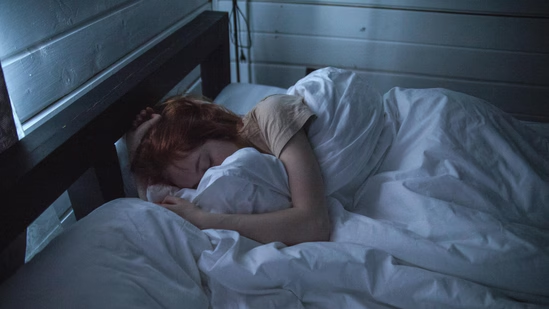
Sleep is the cornerstone of good health. Yet in today’s fast-paced lifestyle, it is generally sacrificed as screen time and late-night work take up more space. Subsequently, people are reeling with stress, fatigue and poor productivity. Sleep is the reset required to relieve everyday stress, but when it is pushed aside continuously, stress keeps building until one is pushed to the brink of burnout.
ALSO READ: Last-minute trip? 13 secret light packing hacks that can save your day
Now the question is, why can’t one take a day off and rest in their own home?Often, in your own space, surrounded by anxiety-inducing stimuli, whether it is a work laptop, endless notifications, or screens of varying sizes, getting the much-needed rest can feel impossible, almost out of reach.
This calls for a detox, an intentional pause that deeply cleanses your energy, refreshing and invigorating you by taking you away from the claustrophobic bubble of constant connectivity, buzz and hubbub of work and personal life. A proper mental and digital reset is required to feel revitalised again.
Recognising the need to reset and recharge, sleep tourism is emerging, where destinations and experiences attempt to promote a restorative pause, helping travellers disconnect.
Let’s hear from hospitality experts on why sleep tourism is growing and becoming a priority for modern travellers.
Why is sleep tourism growing?
Hospitality experts have also observed a steady rise in demand for restorative experiences that help travellers disconnect, recharge, and enjoy deep, restorative sleep.
Mark Sands, vice president of wellness at Six Senses Hotels Resorts Spas, shed light on the collective realisation that quality sleep is not a luxury, but rather an integral part of health. “Sleep is the second-highest wellness priority worldwide, and guests are actively seeking ways to manage stress, anxiety, and cognitive performance in pursuit of a better night’s sleep.”
Since good health is the real luxury, sleep is increasingly being recognised as a luxury, as people are becoming more health-conscious and acknowledge its valuable contribution to overall well-being.
Utami Indah Dewi, director of spa and recreation at JW Marriott Bengaluru Prestige Golfshire Resort and Spa too agreed that nowadays sleep is being seen as a luxury, especially in the age of busy lifestyles. “Sleep tourism today reflects a deeper shift in how people define luxury.”
In the hospitality industry, there is a growing consensus that sleep has become non-negotiable when it comes to travel. It is no longer just a luxury.
Another expert, Dr Kushal Bachani, associate director of spa at The Westin Hyderabad Mindspace, strengthens this travel principle by sharing his observation, “Quality sleep is a fundamental pillar of wellness.” Emphasising how these experiences are curated, he opined,“When we cultivate mindful practices, limit distractions, optimise our environment, and manage stress, we allow the body to restore, the mind to reset, and longevity to thrive.”
Now that sleep has been established as a revered, coveted, and indispensable part of life, it is actively shaping travel experience as well. For a long time, sleep was relegated to the background on trips, with itineraries jam-packed and travellers hopping from one sight to another. But travel is no longer just a checklist; it is reductive to consider that at this age.
Imagine, for those who have been grinding for months, toiling at workplaces with deadlines and returning home to take care of household chores, peace of mind is what becomes the bigger priority on vacation instead of exploration. Otherwise, if the same relentless chase continues even on holiday, it defeats the very purpose of the trip.
Pawan Chahar, general manager at the Jim Corbett Marriott Resort and Spa, confirmed this, adding, “We’re seeing a shift in travel behaviour, where people are no longer just seeking experiences, but are intentionally travelling to slow down, disconnect, and truly rest.”
Dushyant Singh, hotel manager at Mulberry Shades, mentioned an important point that helps to understand what is at the heart of this travel trend. He revealed it to be: ‘intentionality’. Sleep lately on trips has become purposeful. It is actually intentional, not incidental. This means it is planned as a part of the itinerary, not an afterthought. It also implies that the itinerary is planned around restorative rest.
Sleep is no longer at the margins of an itinerary, confined to a quick nap on vacations. Travellers are visiting dedicated destinations and spaces where rest is the main goal of the trip, not a peripheral activity squeezed between the mad rush of sightseeing.
What features are preferred in sleep tourism?
Spa, hotels and recreation centres are actively responding to the growing demand for experiences that prioritise deep, restorative relaxation.
The common features primarily follow a holistic approach, which means a clean, calming environment in touch, surrounded by hills, rivers and forests. Simply being in nature creates a conducive environment for relaxation to unfold. This is in sharp contrast to the concrete jungles in cities, which overwhelm and overstimulate the senses with car honks, towering skyscrapers and a lack of green spaces.
The hospitality experts also note that yoga, meditation, sound healing, and aromatherapy sessions are integrated into these experiences, as they help lower cortisol levels and promote better sleep quality.
Moreover, tourists are encouraged to undertake a digital detox, keeping phones and other electronic gadgets aside, as constant connectivity can quickly raise stress levels.
Specialised treatments also include carefully choosing designed linens, mattresses, and room layouts engineered to evoke comfort and calm the nervous system.
Future of sleep tourism
Just like every trend comes and goes, with one dissipating and another taking its place, where does sleep tourism stand in future? Pawan Chahar at Jim Corbett Marriott Resort & Spa shared an interesting forecast: “Looking ahead, sleep tourism will evolve from a niche trend to a core driver of travel, with destinations like Jim Corbett offering the kind of pause that modern life often lacks.”
With the focus on wellness growing rapidly, sleep tourism is set to become mainstream in future. It will attract all kinds of tourists, not just health-conscious or burnout tourists. It makes the hospitality industry and travellers rethink the true meaning of luxury and leisure in modern travel.