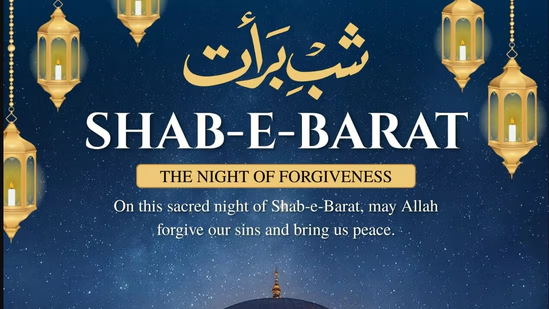
Shab-e-Barat, one of the holiest nights in the Islamic calendar, is observed on the 15th night of Sha’ban, the eighth month of the Islamic lunar year. Known as the ‘Night of Forgiveness,’ it is a time for deep spiritual reflection, when devotees spend the night in prayer, seeking divine mercy, blessings, and forgiveness from the Almighty. From the correct date, history to significance, here is all you need to know. (Also read: Valentine’s Week 2026 Full Calendar: Know the 7 days of love before Valentine’s Day 2026 on February 14 )
When is Shab-e-Barat 2026?
In 2026, Shab-e-Barat is expected to be observed from Tuesday evening, February 3, to Wednesday evening, February 4, according to the Hijri calendar.
“15th Sha’ban (Shab-e-Barat) will start on the evening of Monday, February 2, 2026. This date is subject to change depending on the sighting of the moon,” states Islamic Relief Worldwide.
Fasting on Shab-e-Barat
The holy night of Shab-e-Barat will be observed from the evening of Tuesday, February 3, to Fajr (sunrise) on Wednesday, February 4, 2026. On this day, most devotees will observe the fast of the 15th of Sha’ban, which falls on Wednesday, February 4 this year.
In addition, many people also choose to observe Nafil roza (voluntary fasts) for three consecutive days on the 13th, 14th, and 15th of Sha’ban—corresponding to February 2, 3, and 4, as a way to seek extra blessings and spiritual merit during this sacred period.
Shab-e-Barat 2026 history and significance
Shab-e-Barat is one of the holiest nights in the Islamic calendar, observed with deep devotion and spiritual reflection. Among Shia Muslims, it is believed to mark the birth of Muhammad al-Mahdi, the twelfth Imam. Sunni Muslims, on the other hand, hold that on this night, Allah saved Noah’s Ark from the flood.
The name Shab-e-Barat comes from the Persian word “Shab”, meaning night, and the Arabic word “Barat”, meaning pardon or salvation. It is believed that Allah determines the fate of His followers for the coming year on this night, based on their past deeds, making it a time dedicated to seeking forgiveness and divine mercy.
Some traditions also mention that Prophet Muhammad entered the city of Makkah on this night, while another account says that Hazrat Aisha Siddiqa noticed his absence and found him praying in a Medina cemetery, asking forgiveness for the deceased.
Significance of Shab-e-Barat
Shab-e-Barat is widely regarded as a night of atonement. Devotees pray sincerely, seeking forgiveness for their sins and blessings for the year ahead. Many believe that God decides everyone’s destiny for the upcoming year on this night, taking into account their past actions.
How Shab-e-Barat is Celebrated
Shab-e-Barat is observed across South Asia, including India, Pakistan, Bangladesh, Sri Lanka, Azerbaijan, and Turkey, as well as Central Asian nations such as Uzbekistan, Tajikistan, Kazakhstan, Turkmenistan, and Kyrgyzstan.
On this sacred night, Muslims gather in mosques for prayers and to seek Allah’s forgiveness. People also visit the graves of loved ones to offer prayers. Acts of charity, including distributing food and financial aid to the needy, are a major part of the celebration. Traditional sweets like Halwa and Zarda are prepared and shared with family, friends, neighbours, and the poor. Mosques are often beautifully decorated, and recitations and announcements take place throughout the day, leading up to the night’s prayers.