On September 1, 2021, I received an email from my now-editor, Zara Murao, asking if I would be interested in writing an occasional column for HT Wknd. The team had seen my Twitter threads on food, and thought I might be a good fit. I was elated. I had been blogging for about five years by then and was eager to reach a larger audience.
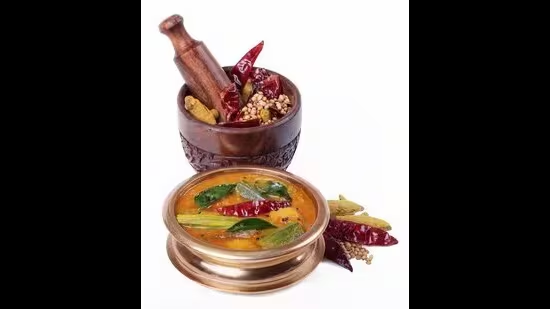
Eat well. Be kind to yourself. And remember, sambar served the next day is just as nutritious and flavourful. Not everything we’ve always done needs to be done the same way. (Shutterstock)
Four-plus years and 131 instalments later, I can’t believe I’m saying goodbye to my beloved column and to the best editor I’ve ever worked with.
Oh, we had some delicate conversations in the early weeks. I remember my first draft, on ketchup, came back covered in strikethroughs that made my head spin. How could anyone not enjoy my long-winded stories and what I thought of as supremely clever food humour? Zara was patient. She taught me the importance of being succinct. Though I still routinely submit 1,000 to 1,200 words for an 800-word space, I know Zara will take care of that, and she always does.
Over four years and more, we covered a range of subjects in food science, from chips, candy and ice-cream to kitchen appliances, cooking techniques, the Maillard reaction.
Along the way, I learned things that blew my mind. One of my favourite columns was on chai. I learned that tannins in black tea are always looking for proteins to bind with. That the whey protein in milk begins to unravel at about 78 degrees Celsius, and more readily binds to the tannins as they leach out of the tea. And that this is why a chaiwala can boil tea leaves in milk for so long without the drink becoming overly bitter.
While researching frying, I learned that only a fraction of the oil, sometimes as little as 20%, is absorbed while the food is submerged. Most of it soaks in after the snack has been removed from the pan and set aside to cool.
I wrote about how foods such as puffed rice, poha and parboiled grains are made using techniques refined over centuries. It was a pleasure to explore and share the history, science and everyday usefulness behind these foods, and understand why they continue to be so widely loved.
I enjoyed looking at everyday meals through a scientific lens. Why was parboiled rice used in dosa batter? (Its thicker texture helps trap air better than raw rice.) What made urad dal so essential to idli batters? (It contains a natural gum called arabinogalactan that holds air in even at high temperatures, helping dosas turn out light and fluffy.)
I compared butter and ghee, wrote about the history of condensed milk, explored the science that holds different kinds of Diwali mithai together.
I have spent long afternoons lost in research, with so many tabs open that my children would shriek in alarm when they borrowed by laptop. I have looked forward to writing, and then reading… because perhaps my favourite part of this job has been your emails.
It still moves me to think that someone copied my email address from the bottom of a print page and took the trouble to write to me. Readers wrote in to joke that they were appropriating my knowledge and claiming it as their own, wowing and surprising people at the breakfast table. Doctors wrote in to say, “I’m glad someone finally said this” and “Can you explore xyz next?”
I remember chuckling, all the miles and hours away in Texas, at some of the feedback I got to my column on cellulose and starch, which I compared to 1970s Bollywood twins. To those of you who wrote once and those of you who wrote in often, each of your messages has meant the world to me.
I step away now to spend time with my family; time that I have looked forward to and knew was coming. I will see you again, from time to time. We aim to bring Sound Bites back soon enough too.
Until then, take care. Eat well. And remember, sambar served the next day is just as nutritious and flavourful. Not everything we’ve always done needs to be done the same way.
(To reach Swetha Sivakumar with feedback, email upgrademyfood@gmail. com. The views expressed are personal)
The Wankhede Stadium wasn’t just buzzing with cricketing action on Saturday night; it was also a star-studded affair in the stands. As India kicked off […]
Whenever you consider a destination for your next trip, what do you usually check off your list? Famous landmarks, hidden gems, scenic offbeat trails, delightful […]
India is blessed with some of the most breathtaking landscapes, and you can experience these views while travelling through some of the luxurious trains that […]